
Layouts and Codecs
A CosId generator produces a number; a codec turns it into text. The two are separate (generation never knows about encoding), so wrapping or counting a generator can never change its text form.
@FunctionalInterface
public interface IdGenerator { long generate(); }

public interface IdCodec {
    String encode(long id);
    long decode(String text);
    default IdCodec withPrefix(String prefix) { ... }
    default IdCodec withSuffix(String suffix) { ... }
}

public record StringIdGenerator(IdGenerator ids, IdCodec codec) {
    public String generate() { return codec.encode(ids.generate()); }
}
Layout: the bits of a time-based id
Layout is the one place of the bit arithmetic of Snowflake-style ids: time | node | seq from the high bits down.
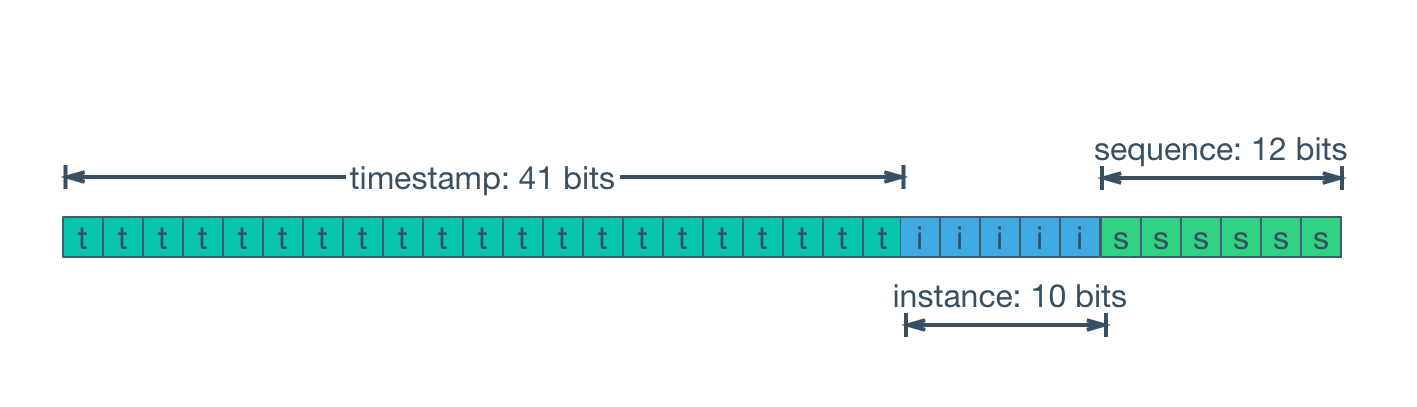
public record Layout(Instant epoch, ChronoUnit unit, int timeBits, int nodeBits, int seqBits, long seqResetThreshold) {
    public long pack(long time, int node, long seq);
    public IdParts unpack(long id);          // IdParts(time, node, seq); parts.instant(layout) is the time
    public int totalBits();
    public boolean isJsSafe();               // totalBits <= 53
    public static boolean isJsSafe(long id);
    public Layout withNodeBits(int nodeBits);
}| Preset | Epoch | Unit | time / node / seq | Total | Notes |
|---|---|---|---|---|---|
SNOWFLAKE_MS (default) | 2019-12-24T16:00:00Z (1577203200000) | ms | 41 / 10 / 12 | 63 | the 4.x default (D16): ids stay numerically continuous after a migration |
SNOWFLAKE_S | the same | s | 31 / 10 / 22 | 63 | |
JS_SAFE_MS | the same | ms | 41 / 3 / 9 | 53 | fits a JavaScript number; at most 8 slots |
JS_SAFE_S | the same | s | 31 / 3 / 19 | 53 | |
COSID_80 | Unix epoch | ms | 44 / 20 / 16 | 80 | the 80-bit CosId: text only, through a PartsCodec |
- A layout is validated when built: time 1–63 bits, node 0–31, sequence 1–62, unit
MILLISorSECONDS(a seconds epoch is a whole second). - The node bits must hold the machine slot. A runtime has one slot in
[0, 2^machine.bits)(D18); start-up fails unlesslayout.nodeBits ≥ machine.bitsfor every time-based generator.JS_SAFE_*(3 node bits) therefore needsmachine.leased.bits: 3or less. seqResetThresholdkeeps the 4.x low-bit scattering: a new time unit starts its sequence at a value up to the threshold (half the range by default), so ids modulo a small number spread evenly.- In Spring,
layoutnames a preset andepoch,unit,time-bits,node-bits,seq-bits,seq-reset-thresholdoverride its fields.
TimeBasedGenerator
One class issues every time-based id, for any layout; 4.x had a class per unit and per encoding, plus decorators.
public final class TimeBasedGenerator implements IdGenerator, PartsIdGenerator, AutoCloseable {
    public long generate();            // layouts of at most 63 bits
    public IdParts nextParts();        // any layout, COSID_80 included
    public Layout layout();
    public int slot();
    public long lastIssuedMillis();
}
Issuing an id is a short critical section: read the time, check it against the slot's window, advance the sequence. Every wait happens outside the lock (the first id after a new slot, an exhausted sequence, a clock regression), which kept 5.0 on par with 4.x at 16 threads (D25).
Clock regression
ClockRegressionPolicy(borrowUpTo, waitUpTo), default 5ms / 1s:
| The clock went back by | The generator |
|---|---|
at most borrowUpTo | keeps issuing on the last time unit ("borrows" the future) |
at most waitUpTo | waits for the clock to catch up |
| more | throws ClockBackwardsException |
ClockRegressionPolicy.FAIL fails at once. None of this affects uniqueness across instances: that is the job of the slot lease's window.
Codecs
| Codec | Text | Notes |
|---|---|---|
Radix.of(radix, width, padStart) | base 2–62 | one class for base 10, 36 and 62; decode checks overflow. Radix.of(62, 11, true) is 4.x's Radix62IdConverter.PAD_START |
Friendly.of(layout, zone, padStart) | yyyyMMddHHmmssSSS-node-seq | time-based ids; the zone is always explicit; padStart pads node and sequence to their widths |
withPrefix, withSuffix | O + text | |
DatePrefix.of(pattern, delimiter, source) | 20261027- + text | source = ID_TIME (the id's own time, time-based only) or NOW (the clock, as 4.x segments did) |
PartsCodec.radix(layout, radix), PartsCodec.friendly(layout, zone) | 80-bit CosId text | each part at a fixed width, so the text sorts like the id |
GroupedCodec.datePrefix(delimiter, valueCodec) | 20261027-000042 | periodic segments: the period, then the value |
your own IdCodec | named by class name or bean name (custom) |
In configuration a codec is an ordered list, applied in the order written. The first item turns the id into text (radix, friendly or custom); without one the text is decimal. The items after it (prefix, suffix, date-prefix) wrap it:
cosid:
  generators:
    order:
      strategy: segment
      store: db
      codec:
        - radix: { radix: 62 }                     # 1. base 62
        - date-prefix: { pattern: yyMMdd, delimiter: "", source: NOW }   # 2. 261027qZ
        - prefix: "O"                              # 3. O261027qZ
    trace:
      strategy: snowflake
      codec:
        - friendly: { zone: Asia/Shanghai }        # 20261027153012123-0003-0017
    token:
      strategy: cosid80
      codec:
        - radix: { radix: 62 }                     # one radix or friendly item
Every codec decodes as well: codec.decode(text) returns the id, and layout.unpack(id) its parts, which replaces the 4.x SnowflakeIdStateParser.
Small helpers
IdGenerators composes the rest, in place of the 4.x classes:
| 4.x | 5.0 |
|---|---|
IntegerIdGenerator | IdGenerators.toInt(ids): an IntIdGenerator, IdOverflowException past Integer.MAX_VALUE |
UncertaintyIdGenerator | IdGenerators.uncertain(ids, bits, random) |
AtomicLongGenerator, UuidGenerator | IdGenerators.local(), IdGenerators.uuid() |
LazyIdGenerator | IdGenerators.lazy(() -> runtime.generator("order")) |
SafeJavaScriptSnowflakeId | Layout.JS_SAFE_MS / JS_SAFE_S |