
SegmentId and SegmentChainId
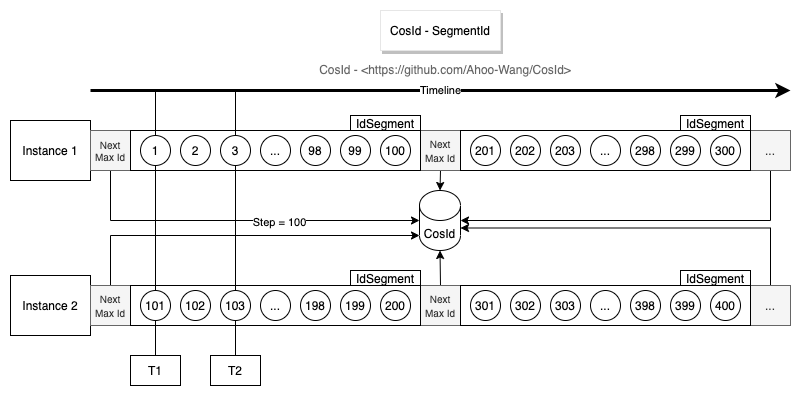
A segment ID comes from a counter in a store. Instead of asking the store for every ID, an instance asks for a block of step IDs at once, a segment, and hands them out from memory.
How it works
The store keeps one counter, the max id, for each generator name in a namespace. An IdSegmentDistributor adds step to it atomically and returns the new value, so the instance owns the IDs from maxId - step + 1 to maxId. No other instance can get them.
- Ordering. Each instance hands out increasing IDs, and its next segment is above its last one: IDs are monotonic per instance. Different instances hold different segments at the same time, so across instances IDs are trend increasing, with a disorder window of about
steptimes the number of instances. With one instance, IDs are monotonic. - Step. Even
step=1is not strictly monotonic across instances: two instances can take consecutive IDs and write them in the opposite order. A smaller step keeps IDs closer to sequential and loses fewer of them on restart (the unused rest of a segment is skipped); a larger step means fewer store calls. - Offset.
offsetis the value the counter starts at when it is created, for example to continue after the IDs of an existing table. It applies only to a counter that does not exist yet. - Availability. Generation needs the store whenever a new segment is needed. A segment chain keeps segments in reserve to ride out short store outages.
DefaultSegmentId
DefaultSegmentId (cosid.segment.mode: segment) takes the next segment on the calling thread when the current one runs out. That thread waits for a store round trip, which shows in the tail latency: P99.99 of 46.6 µs in the historical CosId 1.x JMH results (comparison, benchmark).
SegmentChainId
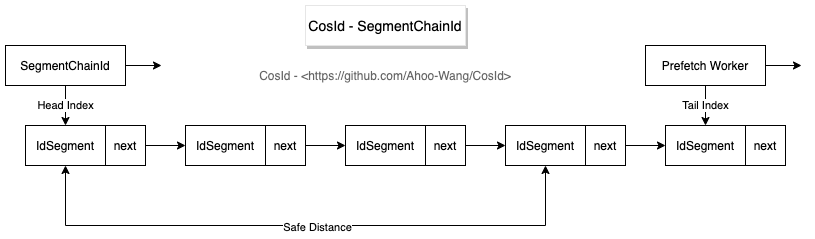
SegmentChainId (cosid.segment.mode: chain, the default) keeps a chain of segments ahead of the one in use. A background prefetch worker keeps the chain at least safe-distance segments long (by default 2), so calling threads almost never wait for the store: about 127 million IDs per second with a P99.99 of 0.208 µs in the same historical results, close to an AtomicLong.
The chain adapts to demand:
- Periodic prefetch. Every
prefetch-worker.prefetch-period(1 second), the worker tops the chain up to the safe distance. - Hunger. When a calling thread finds no segment left, it takes one itself and wakes the worker, which doubles its prefetch distance (up to
max-prefetch-distance, 10,000 segments) and asks the store for that many segments in one call. When demand drops, the distance halves back to the safe distance.
So a small step works well with a chain: the prefetch distance grows when traffic needs it, and IDs stay close to sequential when it does not.
SegmentChainId is AutoCloseable: close() stops its background prefetch, and generation keeps working without it. prefetch-timeout bounds each background prefetch (by default none).
Why every store reaches the same peak
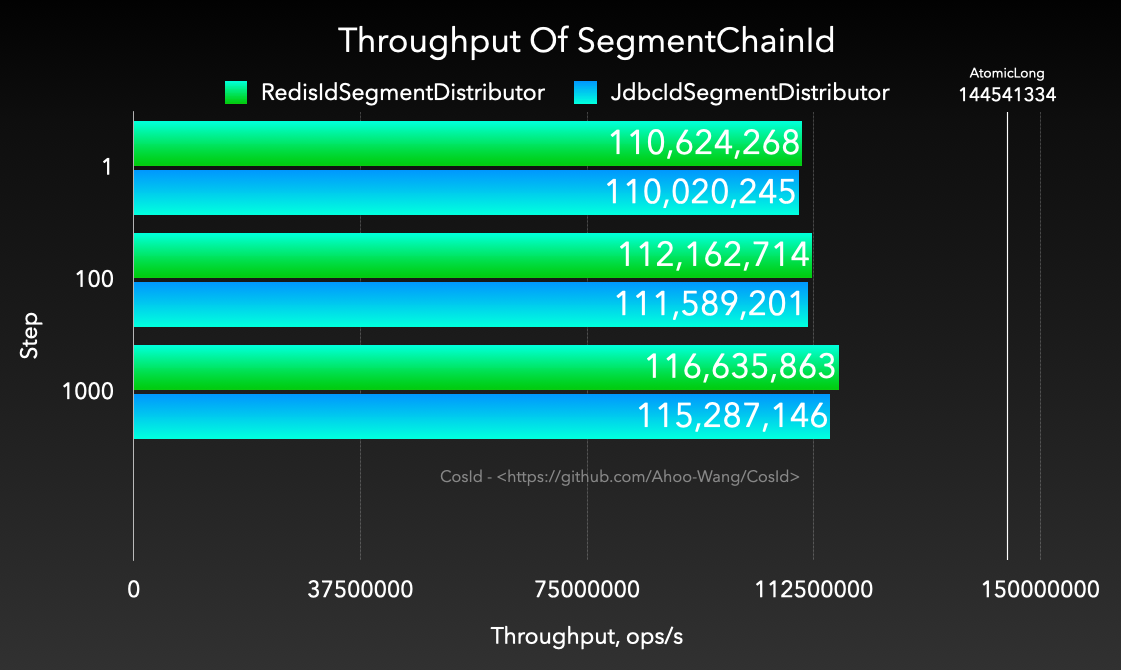
In the benchmark, a Redis and a MySQL segment chain both reach about 120 million IDs per second at step=1000, although Redis answers much faster. Hunger is the reason: the worker keeps doubling the number of segments it takes per call, so with enough time any store hands out IDs faster than threads use them, and the peak is the speed of the in-memory counter.
TPS(SegmentChainId) ≈ step × expansion × TPS(IdSegmentDistributor) × T ≤ TPS(AtomicLong)
Here expansion is the hunger growth factor of the prefetch distance (2: it doubles), and T is how long the benchmark has been running. A faster store only reaches the peak sooner (a smaller T).
Segment time to live
ttl (in seconds, by default forever) makes a segment expire: an instance stops using a segment that is older, skips its remaining IDs and takes a new one. Grouped segments expire at the end of their group on their own.
Grouped segments
A grouped segment restarts its counter for every group, for example every year, month or day, which gives business numbers such as BIZ-20260101-00000001:
cosid:
  segment:
    enabled: true
    provider:
      order_no:
        group:
          by: year_month_day
          pattern: yyyyMMdd
        converter:
          type: to_string
          prefix: BIZ-
          group-prefix:
            enabled: true
          to-string:
            pad-start: true
            char-size: 8
Each group is its own counter in the store, named {name}@{group} (for example order_no@20260101), starting at offset. SegmentId.generateGrouped() returns a GroupedId with both the group and the value, and converter.asString(groupedId) formats it with the group as prefix. See ID recipes for more examples.
Segment stores
cosid.segment.distributor.type selects the store: redis (default), jdbc, mongo, zookeeper or proxy, or the type of an application CosIdStoreProvider. See Choosing a backend.
Configuration
cosid:
  namespace: ${spring.application.name}
  segment:
    enabled: true
    distributor:
      type: redis
    share:
      step: 100
    provider:
      order:
        offset: 10000
        step: 100
This registers the share generator (__share__SegmentId) and a generator named order, both segment chains. See the SegmentId configuration for every property.