
Segment Chain Mode
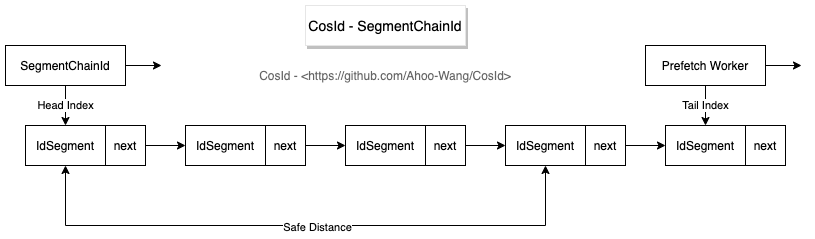
SegmentChainId is SegmentId enhanced version, compared to SegmentId has following advantages:
- Stability: SegmentId stability problem (P9999=46.624(us/op)) mainly because after segment used up synchronously obtain
NextMaxIdleading to (will produce network IO).- SegmentChainId (P9999=0.208(us/op)) introduces new role PrefetchWorker to maintain and guarantee safe distance, ideally making ID obtaining threads almost completely not need synchronous waiting
NextMaxIdobtaining, performance can reach close toAtomicLongTPS performance:12743W+/s JMH benchmark test .
- SegmentChainId (P9999=0.208(us/op)) introduces new role PrefetchWorker to maintain and guarantee safe distance, ideally making ID obtaining threads almost completely not need synchronous waiting
- Adaptability: From SegmentId introduction we knew affecting ID disorder factors have two: cluster scale,
Stepsize. Cluster scale is what we cannot control, butStepis adjustable.Stepshould be as small as possible to increase possibility of ID monotonically increasing.Steptoo small will affect throughput, then how to reasonably setStep? Answer is we cannot accurately estimate all time point throughput demand, so best method is when throughput demand high, Step automatically increases, when throughput low Step automatically contracts.- SegmentChainId introduces starvation state concept, PrefetchWorker will detect according to starvation state whether current safe distance needs expansion or contraction, to obtain trade-off between throughput and orderliness, this is SegmentChainId's adaptability.
Why need SegmentChainId
Through SegmentChainId design diagram we can see, segment chain mode adds a new role PrefetchWorker. PrefetchWorker's main responsibility is to maintain and guarantee safe distance from segment chain head to tail, can also approximately understand as buffer distance. With safe distance guarantee not hard to conclude that all ID obtaining threads only need to get next ID from process memory segment, ideally no need to perform NextMaxId (request NextMaxId to segment distributor, network IO), so performance can reach close to AtomicLong TPS performance:12743W+/s level.
SegmentChainId is SegmentId enhanced version, compared to SegmentId has following advantages:
- TPS performance: Can reach close to
AtomicLongTPS performance:12743W+/s JMH benchmark test. By introducing new role PrefetchWorker to maintain and guarantee safe distance, ideally making ID obtaining threads almost completely not need synchronous waitingNextMaxIdobtaining. - Stability: P9999=0.208(us/op), through above TPS performance description we can see, SegmentChainId eliminates synchronous waiting problem, so stability problem also solved.
- Adaptability: From SegmentId introduction we knew affecting ID disorder factors have two: cluster scale,
Stepsize. Cluster scale is what we cannot control, butStepis adjustable.Stepshould be as small as possible to increase possibility of ID monotonically increasing.Steptoo small will affect throughput, then how to reasonably setStep? Answer is we cannot accurately estimate all time point throughput demand, so best method is when throughput demand high, Step automatically increases, when throughput low Step automatically contracts.- SegmentChainId introduces starvation state concept, PrefetchWorker will detect according to starvation state whether current safe distance needs expansion or contraction, to obtain trade-off between throughput and orderliness, this is SegmentChainId's adaptability.
- So when using SegmentChainId we can configure a relatively small
Stepstep length, then by PrefetchWorker automatically adjust safe distance according to throughput demand, to automatically scale step length.
Can RedisIdSegmentDistributor, JdbcIdSegmentDistributor both reach TPS=120 million/s?
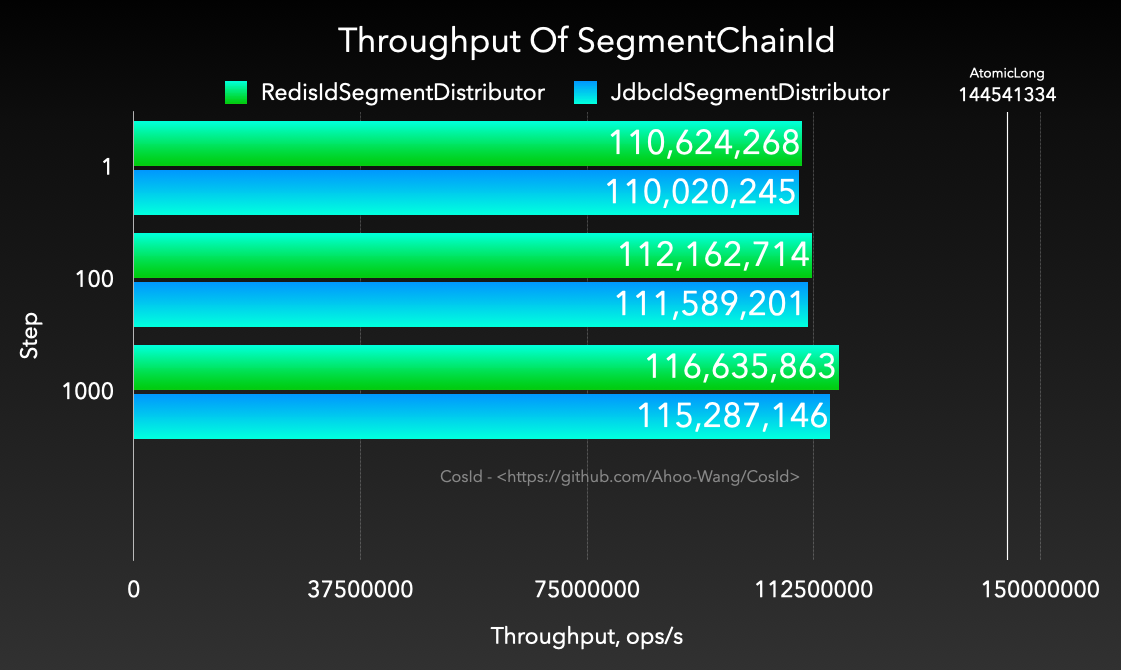
The two figures above brought confusion to many students, why when Step=1000 RedisIdSegmentDistributor, JdbcIdSegmentDistributor TPS performance almost consistent (TPS=120 million/s). RedisIdSegmentDistributor should be higher performance than JdbcIdSegmentDistributor, why can both reach AtomicLong performance upper limit? If I say when Step=1, as long as benchmark test time is long enough, they can still reach AtomicLong performance level (TPS=120 million/s), would you be more confused. Actually the sleight of hand here is PrefetchWorker's starvation expansion leading to, SegmentChainId ultimate performance has no direct relation to distributor TPS performance, because ultimately can expand to performance upper limit due to starvation expansion, as long as give enough time to expand. And why in the figure above when Step=1 TPS difference is still obvious, this is because RedisIdSegmentDistributor expands faster, and benchmark test did not give enough test time.
SegmentChainId benchmark test TPS ultimate performance can approximately use the following formula representation:
TPS(SegmentChainId) ultimate value=(Step*Expansion)*TPS(IdSegmentDistributor)*T/s<=TPS(AtomicLong)
<=TPS(AtomicLong): Because SegmentChainId internal segment usesAtomicLong, so this is performance upper limit.Step*Expansion: Expansion can understand as starvation expansion coefficient, default starvation expansion coefficient is 2. In MySqlChainIdBenchmark, MySqlChainIdBenchmark benchmark test this value is same.TPS(IdSegmentDistributor): This is the only difference in formula. Refers to requesting segment distributorNextMaxIdTPS.T: Can understand as benchmark test run duration.
From above formula not hard to see RedisChainIdBenchmark, MySqlChainIdBenchmark main difference is distributor TPS performance. Distributor TPS(IdSegmentDistributor) larger, reaching TPS(AtomicLong) needed T smaller. But as long as T long enough, any distributor can reach close to TPS(AtomicLong). This also explains why different TPS performance level segment distributors (IdSegmentDistributor) can all reach TPS=120 million/s.