
SnowflakeId
SnowflakeId is a distributed unique ID generation algorithm developed by Twitter, widely used in distributed systems. Its design goal is to generate trend-increasing, globally unique IDs to meet the needs of large-scale systems.
Introduction
INFO
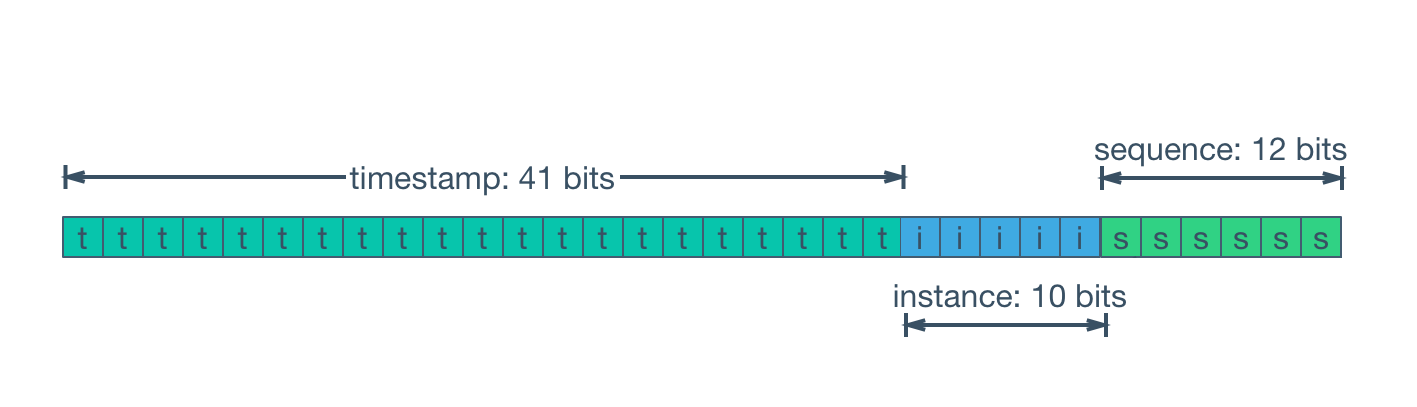
SnowflakeId is a distributed ID algorithm that uses Long (64-bit) bit partitioning to generate IDs.
The general bit allocation scheme is: timestamp(41-bit)+machineId(10-bit)+sequence(12-bit)=63-bit.
- 41-bit
timestamp=(1L<<41)/(1000/3600/24/365), can store about 69 years of timestamps, that is, the usable absolute time isEPOCH+69 years, generally we need to customizeEPOCHas product development time, additionally can extend timestamp bits by compressing other area allocation bits to prolong available time. - 10-bit
machineId=(1L<<10)=1024, that is, same business can deploy 1024 replicas (in Kubernetes concept there is no master-slave replica distinction, directly using Kubernetes definition here). Generally no need to use so many bits, so will redefine according to deployment scale needs. - 12-bit
sequence=(1L<<12)*1000=4096000, that is, single machine can generate about 409W IDs per second, global same business cluster can produce4096000*1024=419430W=4.194 billion (TPS).
From SnowflakeId design we can see:
- 👍
timestampin high bits, single instance SnowflakeId guarantees clock always moves forward (checks local clock rollback), so is locally monotonically increasing. Affected by global clock synchronization/clock rollback SnowflakeId is globally trend increasing. - 👍 SnowflakeId has no strong dependency on any third-party middleware, and performance is also very high.
- 👍 Bit allocation scheme can be flexibly configured according to business system needs to achieve optimal effect.
- 👎 Strongly depends on local clock, potential clock rollback problem will cause ID duplication, in short-term unavailability state.
- 👎
machineIdneeds manual setting, when cluster scale is large,machineIdmaintenance work is very cumbersome and inefficient.
Challenges
Machine ID Allocation
In SnowflakeId, once determined according to business design bit allocation scheme, basically no longer changes, rarely needs maintenance. But machineId always needs configuration, and in cluster cannot repeat, otherwise partitioning principle will be broken leading to ID uniqueness principle destruction, when cluster scale is large machineId maintenance work is very cumbersome and inefficient.
TIP
One point needs special explanation, SnowflakeId's MachineId is a logical concept, not physical concept, so calling it WorkerId is more accurate.
Imagine if MachineId is physical, meaning one machine can only have one MachineId, what problems would arise?
Clock Rollback
Clock rollback's fatal problem is causing ID duplication, conflict (this is not hard to understand), ID duplication obviously cannot be tolerated. In SnowflakeId algorithm, according to MachineId partitioning IDs, we easily understand different MachineId cannot produce same ID. So the clock rollback problem we solve refers to current MachineId's clock rollback problem, not all cluster nodes' clock rollback problem.
MachineId clock rollback problem can be roughly divided into two situations:
- Runtime clock rollback: That is, during runtime the current timestamp obtained is smaller than the last obtained timestamp. This scenario's clock rollback is easy to handle, generally SnowflakeId code implementations all store
lastTimestampfor runtime clock rollback check, and throw clock rollback exception.- Directly throwing exception when clock rollback is not good practice, because downstream users almost have no other handling options (oh, what can I do, wait), clock synchronization is the only choice, when there is only one choice, don't let users choose again.
ClockSyncSnowflakeIdisSnowflakeId's wrapper, when clock rollback occurs it usesClockBackwardsSynchronizerto actively wait for clock synchronization to regenerate ID, providing more user-friendly experience.
- Startup clock rollback: That is, when starting service instance the current clock obtained is smaller than when last closed service. At this time
lastTimestampcannot be stored in process memory. When obtained external storage machine state is greater than current clock, will useClockBackwardsSynchronizerto actively synchronize clock.- LocalMachineStateStorage: Use local file to store
MachineState(machine ID, last timestamp). Because using local file so only applicable when instance deployment environment is stable,LocalMachineStateStorageis applicable. - RedisMachineIdDistributor: Store
MachineStatein Redis distributed cache, this way can guarantee always can get last service instance shutdown machine state.
- LocalMachineStateStorage: Use local file to store
Uneven Modulo Sharding
CosId cleverly solves the uneven modulo sharding problem by introducing the sequenceResetThreshold property, this design provides users with a better experience without sacrificing performance.
JavaScript Numerical Overflow
JavaScript's Number.MAX_SAFE_INTEGER is only 53-bit, if directly return 63-bit SnowflakeId to frontend, will produce value overflow situation (so here we should know backend passing long value overflow problem to frontend, sooner or later will appear, only SnowflakeId appears faster). Obviously overflow cannot be accepted, generally can use the following two handling schemes:
- Convert generated 63-bit
SnowflakeIdtoStringtype.- Directly convert
longtoString. - Use
SnowflakeFriendlyIdto convertSnowflakeIdto more friendly string representation:{timestamp}-{machineId}-{sequence} -> 20210623131730192-1-0
- Directly convert
- Customize
SnowflakeIdbit allocation to shortenSnowflakeIdbit count (53-bit) soIDprovided to frontend does not overflow- Use
SafeJavaScriptSnowflakeId(JavaScriptsafeSnowflakeId)
- Use
Specific Implementation
MillisecondSnowflakeId
MillisecondSnowflakeId is the default implementation of SnowflakeId, it uses System.currentTimeMillis() as timestamp, accurate to millisecond level.
SecondSnowflakeId
SecondSnowflakeId is another implementation of SnowflakeId, it uses System.currentTimeMillis() / 1000 as timestamp, accurate to second level.
DefaultSnowflakeFriendlyId
DefaultSnowflakeFriendlyId is SnowflakeId's wrapper, it converts SnowflakeId to more friendly string representation: {timestamp}-{machineId}-{sequence} -> 20210623131730192-1-0
ClockSyncSnowflakeId
ClockSyncSnowflakeId is SnowflakeId's wrapper, when clock rollback occurs it uses ClockBackwardsSynchronizer to actively wait for clock synchronization to regenerate ID, providing more user-friendly experience.
MachineIdDistributor
MachineIdDistributor is SnowflakeId's machine ID distributor, it is responsible for allocating machine ID, also stores MachineId's last timestamp, for startup clock rollback check.
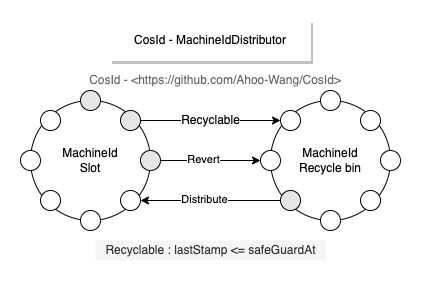
Currently CosId provides the following six MachineId distributors.
ManualMachineIdDistributor: Manually configuremachineId, generally only possible when cluster scale is very small, not recommended.StatefulSetMachineIdDistributor: UseKubernetes'sStatefulSetprovided stable identity ID (HOSTNAME=service-01) as machine ID.RedisMachineIdDistributor: Use Redis as machine ID distribution storage, also storesMachineId's last timestamp, for startup clock rollback check.JdbcMachineIdDistributor: Use relational database as machine ID distribution storage, also storesMachineId's last timestamp, for startup clock rollback check.ZookeeperMachineIdDistributor: Use ZooKeeper as machine ID distribution storage, also storesMachineId's last timestamp, for startup clock rollback check.MongoMachineIdDistributor: Use MongoDB as machine ID distribution storage, also storesMachineId's last timestamp, for startup clock rollback check.
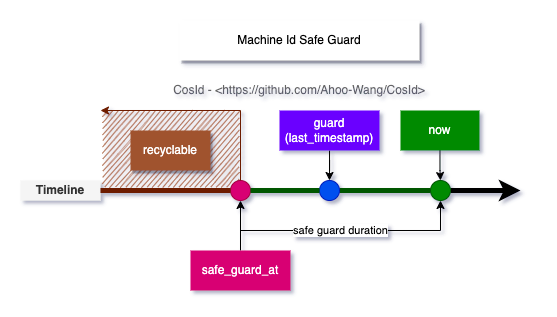
MachineIdGuarder
Configuration
Configuration Example
cosid:
  namespace: ${spring.application.name}
  machine:
    enabled: true
    distributor:
      type: jdbc # Machine ID distributor
    guarder:
      enabled: true # Enable machine ID guarder
  snowflake:
    enabled: true
    zone-id: Asia/Shanghai
    epoch: 1577203200000
    share:
      clock-sync: true # Enable clock rollback sync
      friendly: true
    provider:
      short_id:
        converter:
          prefix: cosid_
          type: radix
          radix:
            char-size: 11
            pad-start: false
      safe-js:
        machine-bit: 3
        sequence-bit: 9