
CosId Proxy
The CosId proxy is a small HTTP server that stands between applications and the store. Applications lease machine ids and take segments from the proxy, and only the proxy holds the store's address and credentials. IDs are still generated inside each application; the proxy is called only for what a store would be called for.
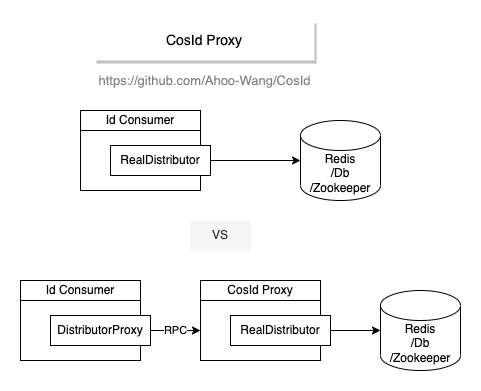
┌──────────────────────────┐      HTTP       ┌───────────────────┐       ┌────────────────────┐
│ Application              │ ──────────────► │ cosid-proxy-server│ ────► │ Redis / JDBC / ... │
│ ProxyMachineLeaseStore   │                 │                   │       │                    │
│ ProxyIdSegmentDistributor│                 │                   │       │                    │
└──────────────────────────┘                 └───────────────────┘       └────────────────────┘
Use it when applications must not reach the store directly, for example across network zones, or to keep one set of store credentials. It adds a service to run and secure, and a network hop at startup, at lease renewal and at segment prefetch.
Running the server
The server is cosid-proxy-server, a Spring Boot application published as the Docker image ahoowang/cosid-proxy. It listens on port 8688 and uses Redis by default; configure its store exactly like an application's, with cosid.machine.distributor.type and cosid.segment.distributor.type.
docker run --name cosid-proxy -d -p 8688:8688 --link redis \
  -e SPRING_DATA_REDIS_URL=redis://redis:6379 \
  -e COSID_PROXY_TOKEN=change-me \
  ahoowang/cosid-proxy:4.0.2
Use --network (or --link redis) so that the container can reach Redis, and a released image tag, such as 4.0.2 (the current release) or latest.
The server refuses to start without a token, see Authentication.
Client
Installation
dependencies {
    implementation(platform("me.ahoo.cosid:cosid-bom:$cosidVersion"))
    implementation(platform("me.ahoo.cosid:cosid-dependencies:$cosidVersion")) // manages the CoApi version
    implementation("me.ahoo.cosid:cosid-spring-boot-starter")
    implementation("me.ahoo.cosid:cosid-proxy")
    implementation("me.ahoo.coapi:coapi-spring-boot-starter")
}<dependencies>
<dependency>
<groupId>me.ahoo.cosid</groupId>
<artifactId>cosid-spring-boot-starter</artifactId>
</dependency>
<dependency>
<groupId>me.ahoo.cosid</groupId>
<artifactId>cosid-proxy</artifactId>
</dependency>
<dependency>
<groupId>me.ahoo.coapi</groupId>
<artifactId>coapi-spring-boot-starter</artifactId>
</dependency>
</dependencies>With Maven, import me.ahoo.cosid:cosid-dependencies as a BOM as well, for the CoApi version.
Configuration
cosid:
  namespace: ${spring.application.name}
  proxy:
    host: http://cosid-proxy:8688
    token: ${COSID_PROXY_TOKEN}
  machine:
    enabled: true
    distributor:
      type: proxy
  segment:
    enabled: true
    distributor:
type: proxy| Property | Default | Description |
|---|---|---|
cosid.proxy.host | http://localhost:8688 | Base URL of the proxy server |
cosid.proxy.token | none | Bearer token sent with every request |
cosid.proxy.connect-timeout | 2s | Connecting to the server; 0 means no timeout |
cosid.proxy.read-timeout | 5s | Waiting for a response, including the machine id claim at startup; 0 means no timeout, but with cosid.machine.distributor.type=proxy it must be positive |
The client side is a MachineLeaseStore and an IdSegmentDistributor like any other: ProxyMachineLeaseStore calls the server's lease API (/machines/v2) to claim, renew and release machine ids, and ProxyIdSegmentDistributor asks it for segments. Ahead-of-time processing and native images do not support the proxy client yet; run applications that use it on the JVM.
Authentication
The server needs at least one bearer token, and fails to start without one. Configure tokens on the server and the same token on every client:
# proxy server
cosid:
  proxy:
    server:
      auth:
        tokens:
          - ${COSID_PROXY_TOKEN}   # list several tokens to rotate them
        public-paths:              # need no token; default: the health endpoint
          - /actuator/health
          - /actuator/health/**
Every request without a valid Authorization: Bearer <token> gets 401, including the actuator endpoints (some of them generate or remove IDs) and the API docs, except the public paths. Public paths are path patterns matched on the decoded path; by default they are the health endpoint under management.endpoints.web.base-path. To open the API docs, add /v3/api-docs/**, /swagger-ui.html and /webjars/swagger-ui/** (the server uses springdoc on WebFlux).
cosid.proxy.server.auth.allow-anonymous: true runs the server without tokens; use it only behind a trusted network boundary.
Server limits
The server checks what clients send, and answers 400 to requests outside these limits:
| Property | Default | Description |
|---|---|---|
cosid.proxy.server.min-safe-guard-duration | 5m | A client may take over a machine id only if its lease was last renewed at least this long ago, by the store's clock. 4.0 clients that send a later cut-off get 400; a shorter guard from a 3.x client is raised to this value with a warning. Keep it at most the clients' cosid.machine.guarder.safe-guard-duration; must not be negative |
cosid.proxy.server.max-clock-skew | 1m | How far ahead of the store's clock (the server's clock for the v1 API) a client's last timestamp may be; a timestamp far in the future would keep a machine id from ever being recycled. 0 disables the check; must not be negative |
cosid.proxy.server.segment.max-step | 1000000000000 | Largest segment step a client may ask for; 0 means no limit. Segment chains ask for step × segments at once and more under load, so set it to at least the largest step × max-prefetch-distance of all clients. offset must be between 0 and Long.MAX_VALUE / 2 |
Deployment security
- Run the server on an internal network only, never exposed to the internet. Anyone who can call it can release a machine id that a live instance holds, and two instances then generate the same IDs.
- A token is a bearer credential: whoever has it can call every endpoint, for every namespace. Send it over HTTPS or inside a service mesh with mutual TLS, keep it in a secret store, and rotate it by listing the new and the old token together.
- Keep
cosid.proxy.server.segment.max-stepfinite, so that one request cannot use up or overflow a counter. - The server does not open JMX. To monitor it over JMX, pass the options in
JAVA_OPTS, with authentication and TLS:
JAVA_OPTS="-Dcom.sun.management.jmxremote.port=5555 \
  -Dcom.sun.management.jmxremote.authenticate=true \
  -Dcom.sun.management.jmxremote.password.file=/opt/cosid-proxy-server/config/jmxremote.password \
  -Dcom.sun.management.jmxremote.access.file=/opt/cosid-proxy-server/config/jmxremote.access \
  -Dcom.sun.management.jmxremote.ssl=true \
  -Djavax.net.ssl.keyStore=/opt/cosid-proxy-server/config/jmx.p12 \
  -Djavax.net.ssl.keyStorePassword=${JMX_KEYSTORE_PASSWORD}"
Unauthenticated JMX gives full control of the JVM; a heap dump also exposes the tokens and the store passwords.
Availability
The server keeps no client state of its own: leases and counters live in its store. Run several servers behind a load balancer for availability. After a server restarts, running clients continue without a restart: the server rebuilds its segment distributors from the store on the next request.
Upgrading from 3.x
- Set
cosid.proxy.tokenon the 3.4.x clients (3.4 sends it, and a server without tokens ignores it). - Upgrade the servers, with the same token in
cosid.proxy.server.auth.tokens. Upgrading them before the clients have the token gives those clients401. - Upgrade the clients. Keep the server's
min-safe-guard-durationat most the clients'cosid.machine.guarder.safe-guard-duration.
4.0 servers keep the deprecated v1 machine API (/machines/{namespace}) for 3.x clients, and 4.0 clients use the v2 lease API, which 3.x servers do not have. See Migrating to 4.0.