
ID Generators
All CosId generators implement one of two interfaces in cosid-core:
public interface StringIdGenerator extends Statistical {
    String generateAsString();
}

public interface IdGenerator extends StringIdGenerator {
    long generate();

    default IdConverter idConverter() {
        return Radix62IdConverter.PAD_START;
    }

    @Override
    default String generateAsString() {
        return idConverter().asString(generate());
    }
}
An IdGenerator produces long IDs and formats them as strings through its ID converter. A StringIdGenerator produces strings only: CosIdGenerator and UuidGenerator are string-only generators and have no generate().
Without a configured converter, generateAsString() returns the ID in base 62, zero-padded to 11 characters (Radix62IdConverter.PAD_START), so the strings sort like the numbers.
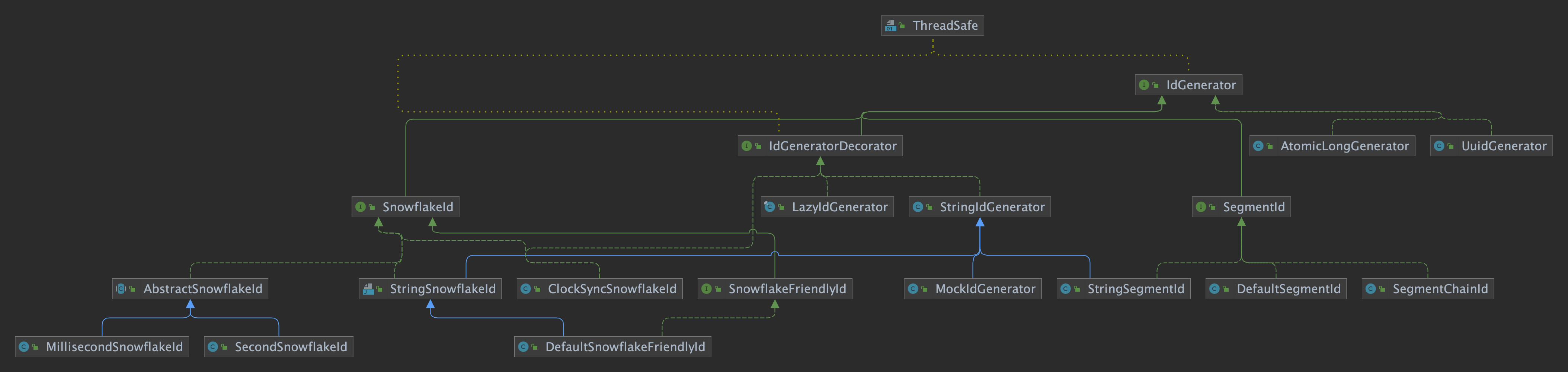
The generators
| Generator | Interface | Coordination | Notes |
|---|---|---|---|
SegmentChainId | IdGenerator (SegmentId) | Takes segments from an IdSegmentDistributor and prefetches ahead | The default segment mode (cosid.segment.mode=chain) |
DefaultSegmentId | IdGenerator (SegmentId) | Takes a segment when the current one runs out, on the calling thread | cosid.segment.mode=segment |
MillisecondSnowflakeId | IdGenerator (SnowflakeId) | Needs a machine id | The default Snowflake layout: 41-bit timestamp, 10-bit machine id, 12-bit sequence |
SecondSnowflakeId | IdGenerator (SnowflakeId) | Needs a machine id | Timestamp in seconds, timestamp-unit: second |
CosIdGenerator | StringIdGenerator | Needs a machine id | Radix-62, radix-36 or friendly strings; up to 20 machine id bits |
UuidGenerator | StringIdGenerator | None | UuidGenerator.INSTANCE, random UUID strings, UUID.randomUUID().toString() |
Decorators add behavior to a generator without changing its type: ClockSyncSnowflakeId waits out a clock that moved backwards, LeasedSnowflakeId stops generating once the machine id lease is lost, and StringSnowflakeId and StringSegmentId use a configured converter for generateAsString(). The Spring Boot starter applies them from configuration.
Choosing a generator
- Do you need a
long? Most databases and ORMs want a numeric primary key. Use a segment chain or a Snowflake ID. If strings are fine, every generator can produce them. - Do you want IDs close together? A segment chain hands out near-sequential numbers (
1, 2, 3, ...per instance, in blocks ofstep), which keeps keys short and indexes dense. Snowflake IDs are large numbers (around 260). - Must the ID carry its time? A Snowflake ID can be parsed back into its timestamp, machine id and sequence, which also lets you shard by time with the ID alone (see interval sharding).
- What do you already run? A segment chain needs a segment store that is reachable when it prefetches; Snowflake and CosIdGenerator need a store only to lease a machine id at startup and to renew it.
- How many instances? The default Snowflake layout has 10 machine id bits, 1024 instances per namespace.
CosIdGeneratorhas 20, about a million. - Is the ID shown to a browser? JavaScript numbers are exact only up to 253. Send Snowflake IDs as strings, or use a JavaScript-safe layout.
When in doubt, start with a segment chain for primary keys and business numbers.
Using a generator
With the Spring Boot starter, every configured generator is registered in the IdGeneratorProvider under its name, and the share generator under __share__:
@Service
public class OrderService {
    private final IdGeneratorProvider provider;

    public OrderService(IdGeneratorProvider provider) {
        this.provider = provider;
    }

    public long newOrderId() {
        return provider.getRequired("order", IdGenerator.class).generate();
    }

    public long newShareId() {
        return provider.getShare().generate();
    }
}
Each generator is also a bean named {name}SegmentId or {name}SnowflakeId (for example orderSegmentId, __share__SnowflakeId), and the CosId generator is the CosIdGenerator bean, registered in the provider as cosid. See ID Generator Provider for the lookups, and @CosId to fill entity fields without calling a generator yourself.