
SnowflakeId
A SnowflakeId packs a timestamp, a machine id and a sequence into one 63-bit long. Every instance generates IDs on its own, with no call to a store, as long as no two instances use the same machine id at the same time.
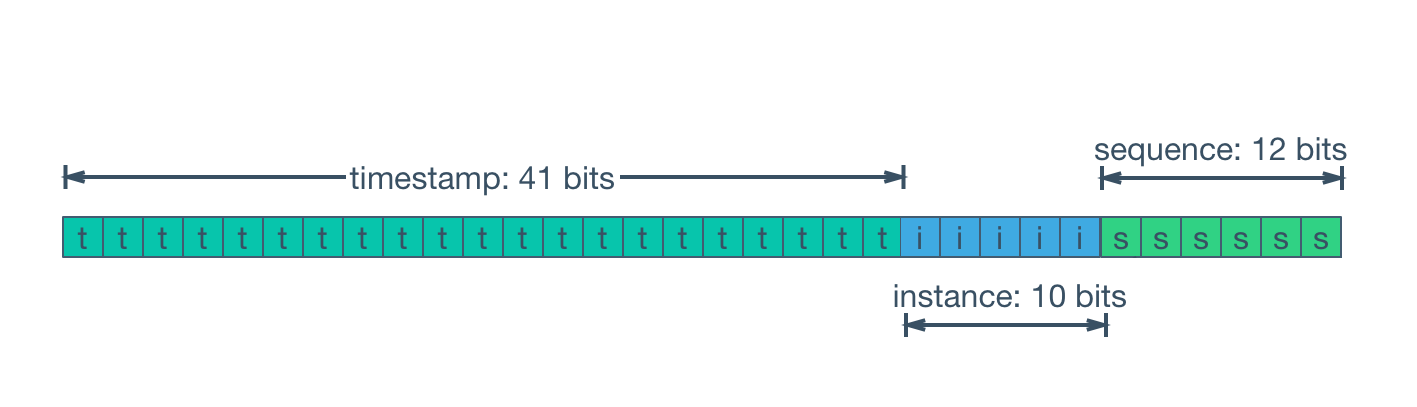
Layout
The default layout, MillisecondSnowflakeId, is timestamp (41 bits) + machine id (10 bits) + sequence (12 bits) = 63 bits:
- Timestamp: milliseconds since the
epoch. 41 bits last about 69 years. CosId's default epoch is1577203200000(2019-12-24T16:00:00Z); a later epoch leaves more years. - Machine id: 10 bits allow 1024 instances in one namespace at the same time. See Machine ID for how an instance gets one.
- Sequence: 12 bits allow 4096 IDs per millisecond per instance, about 4 million per second. When the sequence runs out, the generator waits for the next millisecond.
SecondSnowflakeId (timestamp-unit: second) counts seconds instead. new SecondSnowflakeId(machineId) uses 31 + 10 + 22 bits, but the starter keeps the configured bits (41 + 10 + 12 by default) and epoch for timestamp-unit: second: set timestamp-bit, sequence-bit and an epoch in seconds explicitly, as in the configuration example. Any layout whose bits add up to at most 63 works; SnowflakeId.layout() returns it, and machine id bits are limited to 31.
Because the timestamp is in the high bits, IDs of one instance increase monotonically, and IDs across instances are trend increasing, as far apart as the host clocks are.
Sequence reset
At low traffic, every millisecond would start its sequence at 1, so most IDs would end in the same few values, and sharding by id % n would put almost all rows in one shard. CosId continues the sequence across milliseconds and restarts it only once it has passed sequence-reset-threshold (by default half the sequence range, 2047 for 12 bits). This spreads the low bits without costing throughput.
Clock backwards
A clock that moves backwards could make an instance issue the same timestamp and sequence twice.
- While running, the generator keeps its last timestamp and detects a clock behind it. With
clock-sync: true(the default),ClockSyncSnowflakeIdwaits until the clock catches up: it spins for a jump of at mostcosid.machine.clock-backwards.spin-threshold(1 ms), sleeps for a jump up tobroken-threshold(500 ms), and throwsClockTooManyBackwardsExceptionbeyond that. - After a restart, the last timestamp is gone from memory. The machine id lease keeps a watermark, the last timestamp issued under that machine id, and a new owner waits until its clock passes it. See Machine ID.
JavaScript-safe IDs
JavaScript numbers are exact only up to 253 - 1, so a 63-bit ID sent as a JSON number loses its low digits in a browser. Either:
- send it as a string: an ID converter (
radix,to_string,snowflake_friendly), orcosid-jacksonfor selected fields; or - use a 53-bit layout.
SafeJavaScriptSnowflakeId.ofMillisecond(machineId)creates one with 41 timestamp, 3 machine id and 9 sequence bits; with the starter, set the bits on a named generator:
cosid:
  snowflake:
    provider:
      safe-js:
        namespace: ${spring.application.name}-safe-js
        machine-bit: 3
        sequence-bit: 9
Fewer machine id bits mean fewer instances: 3 bits allow 8. Give such a generator its own namespace: an instance holds one machine id per namespace, and one leased for 10 bits may not fit in 3.
Friendly IDs
SnowflakeFriendlyId formats an ID as {timestamp}-{machineId}-{sequence}, for example 20210623131730192-1-0, and parses it back. With the starter, use converter.type: snowflake_friendly; the timestamp is formatted in cosid.snowflake.zone-id.
Implementations
| Class | Role |
|---|---|
MillisecondSnowflakeId | Millisecond timestamps, the default |
SecondSnowflakeId | Second timestamps |
ClockSyncSnowflakeId | Waits out a clock that moved backwards (clock-sync: true) |
LeasedSnowflakeId | Throws MachineIdLostException once the machine id lease is lost or expired (cosid.machine.guarder.fail-fast: true) |
StringSnowflakeId | Uses a configured converter for generateAsString() |
DefaultSnowflakeFriendlyId | Friendly string format |
Configuration
Snowflake IDs need a machine id, so enable the machine id as well:
cosid:
  namespace: ${spring.application.name}
  machine:
    enabled: true
    distributor:
      type: redis
  snowflake:
    enabled: true
    provider:
      order:
        converter:
          type: radix
This registers the share generator (__share__SnowflakeId) and a generator named order. See the SnowflakeId configuration and the machine ID configuration for every property.